Hybrid Networks
Integrating TETRA and Broadband for Mission Critical Communications
Hybrid Networks: Integrating TETRA and Broadband for Mission Critical Communications
As the critical communication landscape continues to evolve, the shift from legacy PMR (Professional Mobile Radio) systems like DMR and TETRA to high-speed broadband networks is accelerating. However, despite this technology transition, TETRA remains essential for ultra-reliable mission critical voice and foundational radio service. Today, forward-thinking organisations worldwide are adopting hybrid networks TETRA broadband to combine the robust, resilient capabilities of TETRA narrowband networks with the high-speed data capacity of mobile broadband (4G LTE and 5G). This hybrid system serves as the cornerstone mission critical strategy for public safety transport, utilities, and critical infrastructure management.
What is a Hybrid TETRA Broadband Network and How Does It Work?
A hybrid network seamlessly merges a traditional TETRA network with a modern broadband network. While TETRA continues to handle critical voice, network control, and vital features like Direct Mode Operation (or mode operation DMO) for off-network coverage, the broadband component delivers mission critical broadband services. This integrated technology setup supports heavy data transmission, real-time HD video streaming, and connected IoT applications for every user in the field.
By merging these technologies, a hybrid TETRA LTE architecture will protect legacy investments while paving the way for future digital transformation. A hybrid device can dynamically switch between networks depending on available coverage, ensuring uninterrupted communication and maximum security for public safety organisations. Hybrid models are being deployed accross the world to enhance operational control. Network operators and advanced software ecosystems clearly demonstrate how hybrid networks are shaping the future of critical MCX (Mission-Critical Services).
The Enduring Role of TETRA and the Rise of Broadband Services
For decades, TETRA has been the gold standard for critical communication, offering unmatched quality of service, broad coverage, and operational security. But as the need for real time intelligence and multimedia sharing grows, broadband services are becoming indispensable for efficient incident management.
The current transition involves integrating 3GPP standards such as PTT (Mission Critical Push-To-Talk), MCVideo, and MCData—collectively known as MCX—into everyday operations. Through a hybrid TETRA approach, any field user enjoys the best of both worlds:
-
Mission Critical Voice: Utilizing the tried-and-tested TETRA or PMR radio system for uncompromised voice delivery.
-
Mission Critical Services & MCX: Leveraging 4G/5G technology for massive data exchange, secured via a dedicated VPN or managed through a private slice by an MNO (Mobile Network Operator) with centralized traffic management.
Addressing the Bandwidth Challenge with ENENSYS Multicast Technology
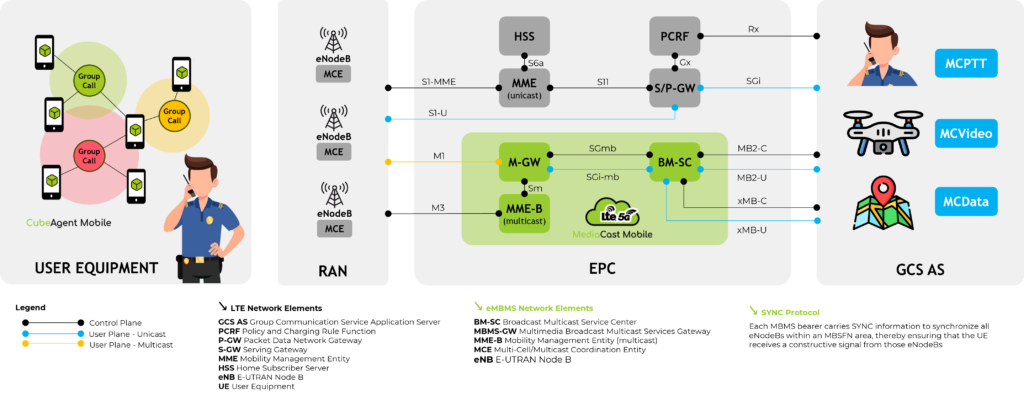
As you bridge the gap between voice data and rich media capabilities, a significant network architecture challenge arises. Traditional TETRA networks are natively multicast (designed to broadcast efficiently from one-to-many). Conversely, standard 4G/5G broadband networks rely on unicast (one-to-one), which will cause congestion when multiple users demand high-bandwidth video simultaneously.
To optimize hybrid TETRA LTE deployments and guarantee quality of service, ENENSYS provides essential eMBMS (Multicast) technology. By activating Multicast on your LTE or 5G infrastructure, your system ensures that mission critical communications and MCX feeds are delivered simultaneously to every device in a given cell without compromising security or network control. This approach minimizes bandwidth usage, expands effective coverage capacity, and streamlines fleet management. We invite you to download our dedicated white paper to learn how this technology optimizes your hybrid network deployment.
Optimize your network with Multicast

Industry Use Cases: Safety, Transport, and Utilities Management
Advanced communication solutions are no longer confined to police and fire departments. The demand for reliable service and unified operational control spans multiple verticals:
-
Public Safety: First responders rely on tetra broadband networks to share real-time video, maps, and database queries while maintaining secure radio contact and reliable coverage.
-
Safety Transport Utilities: Railways, airports, and energy grids benefit from hybrid tetra architectures to handle precise geolocation, remote asset management, and ensure fail-proof systems continuity under central control.
Frequently Asked Questions
Will TETRA be completely replaced by LTE/5G in the future?
While the mobile broadband migration is underway, the enduring role of TETRA ensures it will coexist with 4G/5G technologies for many years. A hybrid TETRA strategy is the most pragmatic long term solution to maintain uninterrupted service, preserve security, and guarantee continuous radio coverage.
How do hybrid networks guarantee security and control?
Hybrid networks employ modern end-to-end encryption, strict user authentication, and robust access control. They rely on private MNO slices or secure VPN tunnels to protect mission critical data, MCX applications, and critical voice.
What is the benefit of Direct Mode Operation (DMO) on a TETRA device?
Direct mode operation allows a device to communicate directly with another radio without relying on network coverage or a central cell tower. It is a vital fail-safe service for critical communications when personnel operate in deep indoors or off-grid areas.