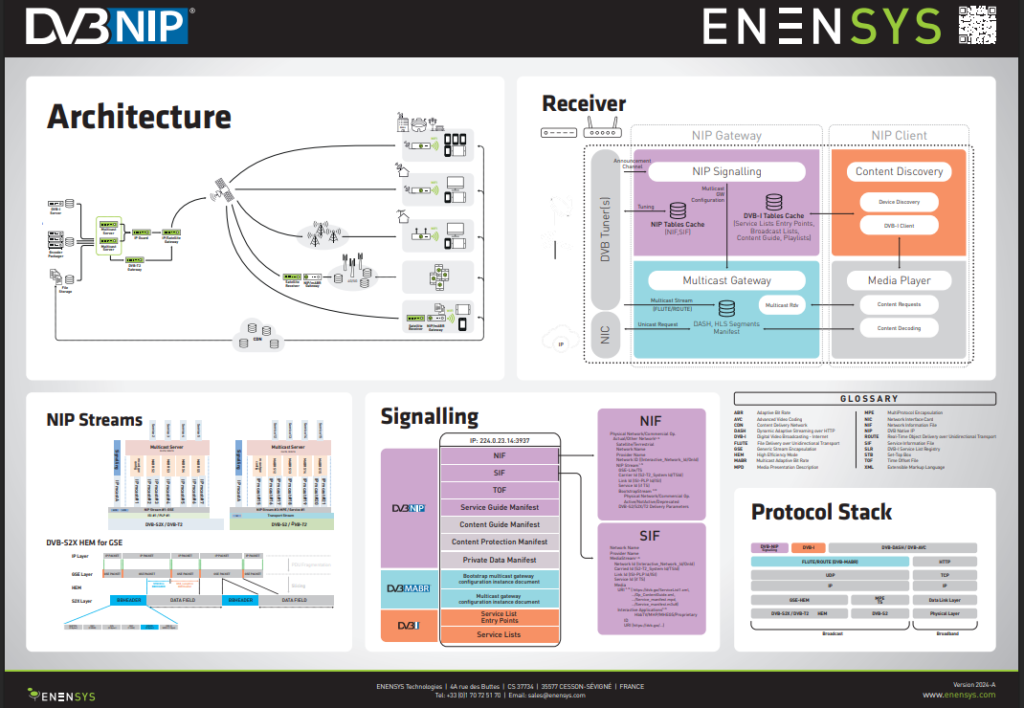
What Is DVB-NIP?
DVB-NIP (Digital Video Broadcasting – Native IP) is a modern standard that enables the transmission of media and data directly over IP-based infrastructure using satellite or terrestrial delivery. Developed by the DVB Project and standardized by ETSI, it reflects the evolving way people access video—on connected devices, over broadband, and across both live and on-demand services.It redefines traditional broadcast distribution by carrying native IP formats instead of relying on legacy MPEG-2 Transport Streams, thereby aligning broadcast capabilities with today’s digital media landscape and IP-centric media workflows.By leveraging a multicast-friendly and broadcast-efficient transport layer, DVB-NIP provides a unified platform for delivering linear TV, OTT formats, and data services accross satellite and terrestrial broadcast links.

Standardisation
DVB-NIP was developed within the DVB Project to address the growing need for IP-centric broadcast solutions supporting large-scale multicast distribution. The standard specifies mechanisms for:
- Native IP Packet Transport: IP datagrams carried directly over broadcast physical layers
- Forward Error Correction (FEC): Robust error protection optimized for broadcast channels
- Service and session Management: Identification, announcement and signalling of IP service flows
- Application support: efficient delivery of HTTP-based streaming formats and other IP applications
The standard is published and maintained by the DVB Project. It extends DVB’s transport ecosystem toward IP-native delivery for broadcasters, satellite operators and content aggregators.
The latest version of the DVB-NIP standard can be found here: https://dvb.org/?standard=native-ip-broadcasting
How It Works
Traditional DVB systems deliver IP services by encapsulating them into MPEG-2 TS, adding overhead and limiting native IP integration. DVB-NIP removes this layer by:
- Defining a broadcast transport layer for IP packets
- Using minimal encapsulation suited for IP datagrams
- Reducing protocol overhead and processing latency
This approach preserves the intrinsic multicast efficiency of broadcast networks while enabling seamless compatibility with standard IP applications
DVB-NIP uses multicast to deliver a single media stream to many users at once. This makes it ideal for reaching large audiences efficiently, especially during periods of high demand.
Video is prepared using familiar streaming formats like DASH or HLS and passed through a gateway into a distribution network. Compatible receivers—such as smart TVs, mobile devices, and set-top boxes—access the stream over IP using appropriate software.
DVB-NIP solution
Service Architecture
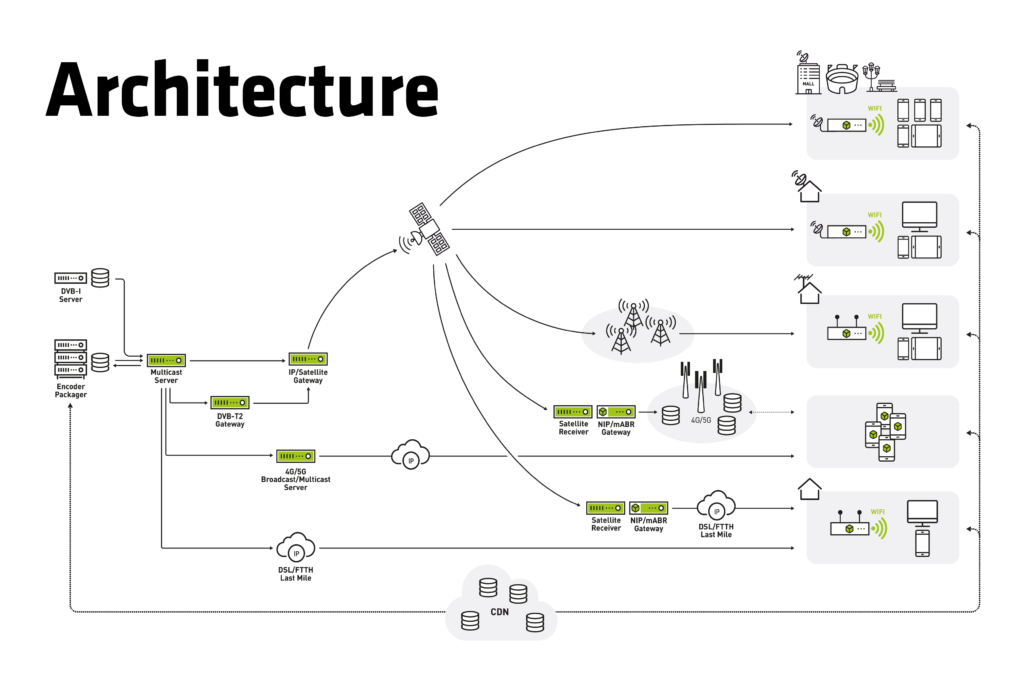
Headend ingestion
At the broadcast headend, DVB-NIP platforms:
- Ingest IP sources (RTP/UDP, MPEG TS, file assets, web origin servers)
- Map IP flows into DVB-NIP service instances
- Apply multicast addressing and service identifiers
This architecture supports both live and file-based content, enabling unified delivery pipelines.
Signalling and session management
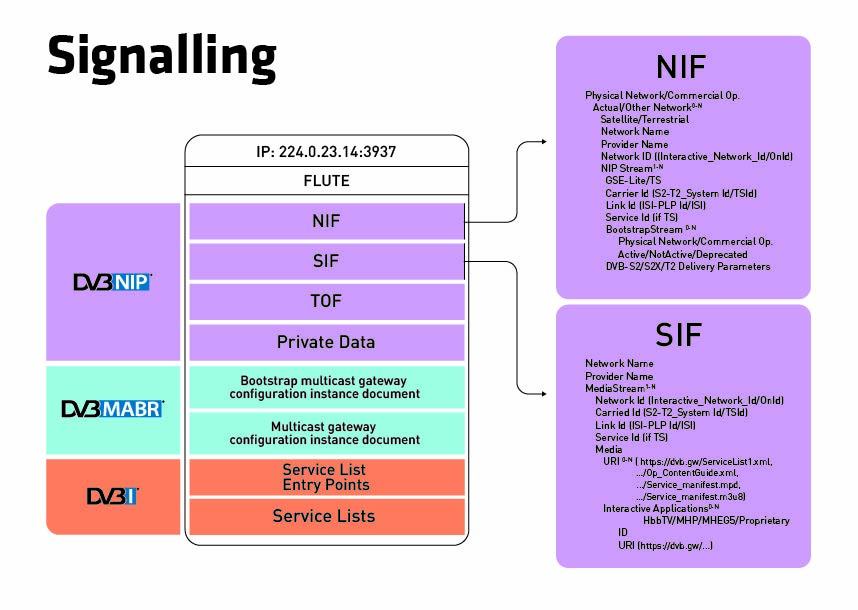
DVB-NIP defines:
- Service announcement schemes: enabling receivers to discover and join IP flows
- Session IDs and Group Addressing: for organized multicast reception
- Optional metadata and descriptors
Receiver models
Native IP receivers are devices capable of:
- Listening to DVB-NIP multicast flows
- Parsing service announcements
- Delivering IP packets directly to applications or middleware
This may include set-top boxes, home gateways, connected TVs, smartphones and tablets with appropriate client stacks.

Key Advantages
- Scalable Delivery – Reach wide audiences without overwhelming networks
- Efficient Use of Infrastructure – Multicast reduces bandwidth consumption
- Future-Ready Design – Built on open specifications for long-term support
- Reliable Access – Ensures availability even in remote or underserved areas
- Flexible Integration – Supports hybrid broadcast and broadband workflows
Comparing Approaches
| Feature |
Traditional Broadcast |
DVB-NIP |
| Transport Format |
MPEG-TS |
Native IP |
| Device Compatibility |
Legacy receivers |
Connected and mobile devices |
| Content Formats |
Linear only |
Linear Adaptive streaming (DASH/HLS) and VOD |
| Network Efficiency |
Dedicated channels |
Shared multicast delivery |
| Application Scope |
Narrow |
Broad and flexible |
Practical Applications
1. Next generation DTH TV (DTH 2.0)
Enhances existing DTH operations by adding live streaming and push VOD, making DTH competitive against emerging OTT and ISP competition. It offers the possibility to connect a smartphone or any mobile device to the satellite receiver to watch any live or vod content anywhere in the home, but also to download content to watch it now or later and with or without a return to internet.
2. Education & Outreach
In areas with poor internet connectivity, DVB-NIP over satellite can distribute learning materials and vital information, supporting public services across long distances. It is perfectly adapted for school where school content and lectures are not available to all students. DVB-NIP offers a cost effective solution to deliver HLS livestream of educational content & PVOD for lectures, papers, presentations or e-learning modules.
3. Mobility
In many locations, mobile networks are limited, which means limited or no availability of live video in cars, boats, aircrafts
4. Hospitality
Enjoy streaming services without depending on connectivity’s network
5. Edge caching
Feed at once local CDNs/POP for 4G/5G distribution
Looking Ahead
As audiences expect higher quality and more flexibility, native IP delivery is becoming essential. DVB-NIP bridges traditional media infrastructure with digital-first expectations, offering a low-latency, scalable solution for the next generation of content distribution.
FAQs
- What is DVB-NIP used for?
- It enables the efficient transmission of video, data, and media services using IP formats over satellite or terrestrial networks.
- What types of applications are supported?
- Live video & vod for DTH2.0, educational content, public avenues or hospitality
- Are today’s devices compatible?
- Yes. Many set-top boxes, and mobile platforms can support this format with the right software setup.
- How does it compare to OTT?
- Unlike unicast OTT, which can strain networks, multicast delivery is far more scalable—especially useful during peak traffic.
- Who’s using it today?
- Early deployments and pilots are underway across Europe, including by operators like Eutelsat and SES.
Learn More
ENENSYS offers complete DVB-NIP solutions—from content gateways to service discovery modules. Whether you’re upgrading infrastructure or launching IP-based services, our technology ensures a smooth and future-ready deployment.
DVB-NIP solution