
eMBMS
Group communications at scale over 4G LTE networks
What Is eMBMS?
eMBMS (evolved Multimedia Broadcast Multicast Service) is the 3GPP standard that brings broadcast and multicast delivery to 4G LTE networks. Also known as LTE Broadcast or LTE Multicast, it sends a piece of content only once to an unlimited number of devices located in the same area, instead of opening one unicast connection per user.
This approach keeps the network available when it matters most. During a major incident, a live event or a nationwide software update, thousands of users can receive the same video, voice or file without congesting the cell. eMBMS has already been tested and deployed in pioneer public safety networks worldwide.
Standardisation
eMBMS is developed and maintained by the 3rd Generation Partnership Project (3GPP). It builds on the MBMS foundation introduced for 3G in Release 6 and has evolved release after release:
- Release 9 – eMBMS for LTE, with MBSFN (MBMS Single Frequency Network) transmission
- Release 13 – SC-PTM (Single Cell Point-to-Multipoint), to adjust the multicast area down to a single cell
- Release 13/14 – Mission Critical Services support (MCPTT, MCData, MCVideo) over multicast
- Release 14 to 16 – FeMBMS, adding the xMB interface for content providers and extended TV services, which became the basis of 5G Broadcast
Key specifications include TS 23.246 (architecture), TS 26.346 (MBMS protocols and codecs) and TS 36.300 (radio access).
Visit 3gpp.org for the latest versions.
How It Works ?
In unicast, each device receives its own copy of the stream. Radio resources grow with every new user until the cell saturates. With eMBMS, content is delivered over a shared radio bearer that every device in the area can receive at the same time. The cost in spectrum stays the same whether 10 or 10,000 users are watching.
eMBMS relies on proven IP delivery mechanisms: FLUTE for file delivery, application-layer FEC (Raptor) for robust reception, and DASH, HLS or RTP for streaming. Devices can report reception quality, and missing packets can be repaired without retransmitting the full content. The network can switch dynamically between unicast and multicast depending on the number of users consuming a service.
Service Architecture
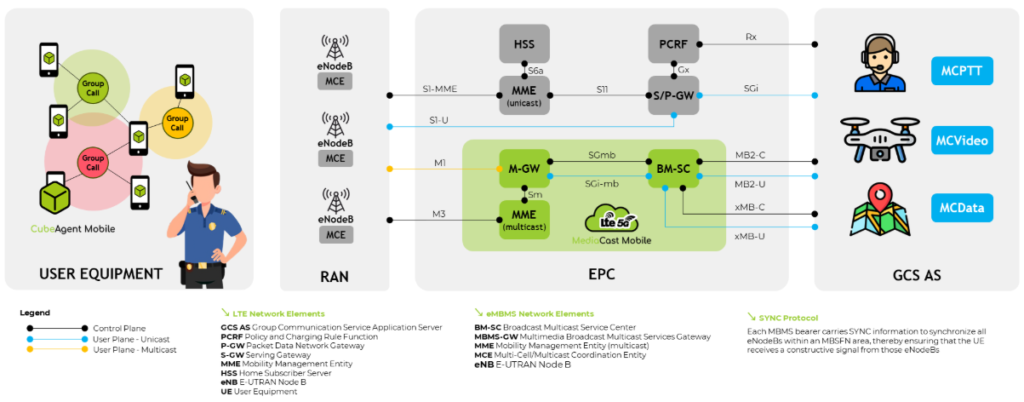
Broadcast Multicast Service Center (BM-SC) – Entry point for content. It schedules sessions, applies FEC, handles service announcement and security, and collects reception reports.
MBMS Gateway (MBMS-GW) – Distributes the IP multicast traffic to all eNodeBs of the service area and manages session control with the MME.
Multi-cell Coordination Entity (MCE) – Allocates radio resources and synchronises transmission across cells so that neighbouring eNodeBs broadcast the same signal (MBSFN).
Receiver side – eMBMS-capable devices run a middleware that discovers services, receives multicast sessions and hands content to applications such as MCX clients or video players.
Key Advantages
- Extreme scalability – Serve thousands of users in the same area with the radio resources of one
- Network availability in crisis – Avoid cell congestion when everyone connects at once
- Synchronised delivery – All devices receive the same content at the same time
- Faster file delivery – Up to 2.5x faster file downloads in semi-congested networks
- Spectral and battery efficiency – Better use of spectrum than unicast, and lower device power consumption
- Built on standard LTE – Works on commercial or private 4G networks with existing 3GPP equipment
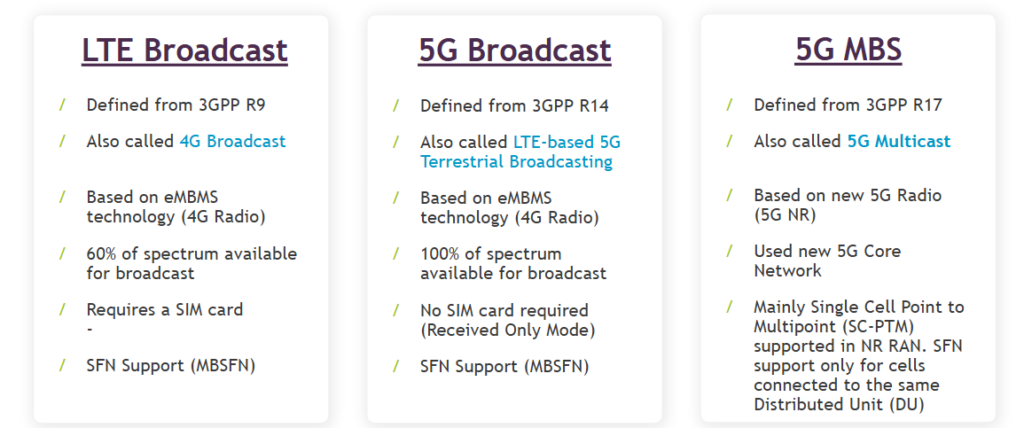
Comparing eMBMS / 5G Broadcast / 5G-MBS
Practical applications
1. Public safety and first responders Mission Critical Push-To-Talk, video and data delivered to entire teams at once, even during large-scale incidents. Emergency alerts and video surveillance feeds reach every officer in the area.
2. Private mobile networks Utilities, industry, transport and defence use eMBMS on their private LTE networks to broadcast group communications and optimise scarce spectrum.
3. Filecasting and software updates Push firmware, maps or documents to large device fleets in one transmission, with FEC and file repair for reliable delivery.
4. Live video and events Stream live TV or event content to crowded venues such as stadiums without saturating the network.
5. Transportation and utilities Deliver operational information, passenger information or telemetry configuration to many terminals simultaneously.
ENENSYS eMBMS solution
ENENSYS offers a unique end-to-end eMBMS solution, covering both the multicast server and the device client:
- MediaCast Mobile – 3GPP-compliant 4G/5G multicast delivery server (BM-SC, MBMS-GW, MME-B, MCE functions) with dynamic unicast/multicast switching, FEC and file repair, and reception reporting
- CubeAgent – 3GPP eMBMS middleware for devices, including a Mission Critical version for MCX applications
- ccBOX – Complete 4G/5G multicast network in a box (EPC, BM-SC, MCE/eNodeB) for R&D, interoperability testing, demonstrations and field trials
ENENSYS eMBMS technology is trusted by leading public safety networks, with major worldwide references. It was deployed within the Airbus Private Mobile Network in Paris in less than three months (PR).
Looking ahead
eMBMS is the proven foundation of mobile multicast today. Its successor, 5G-MBS, carries the same principles into 5G Standalone networks. ENENSYS solutions are designed to support both, giving operators a clear migration path from 4G to 5G.
[Discover 5G-MBS →]
FAQ
- What is eMBMS used for? eMBMS delivers the same content to many users at once over LTE: group calls, live video, alerts and file distribution. It is widely used for mission critical communications.
-
Is eMBMS the same as LTE Broadcast? Yes. LTE Broadcast and LTE Multicast are commercial names for eMBMS.
-
Do devices need to be specific? Devices need an eMBMS-capable chipset and a middleware layer. Many LTE chipsets and rugged public safety devices already support it.
-
Can eMBMS run on a private network? Yes. eMBMS works on both public operator networks and private LTE networks, such as those used by public safety agencies and utilities.
-
How does eMBMS relate to 5G? eMBMS is the 4G technology. 5G-MBS is its native 5G evolution, introduced in 3GPP Release 17.
Learn More
Talk to our experts about deploying multicast on your 4G network.