
Optimize your 4G and 5G mobile networks with Multicast
Remove the constraints of bandwidth by adding eMBMS or 5G-MBS to your infrastructure

CRITICAL COMMUNICATIONS
Remove the constraints of bandwidth by adding eMBMS or 5G-MBS Multicast to your mobile network infrastructure
Multicast technology lets your 4G/5G network deliver the same content once to an entire group of users. With eMBMS on LTE and 5G-MBS on 5G, ENENSYS brings 3GPP-standardized multicast transmission to mission-critical communications, public safety and private networks, so every user receives voice, video and data at the same time, without congesting the radio network.
The Broadband PMR Challenge
Transitioning from legacy narrowband networks (TETRA/P25) to 4G and 5G brings essential broadband services to first responders: live video, multimedia content and heavy data transfer. However, standard 4G and 5G technology relies on one-to-one delivery, called unicast. Each user receives a separate copy of the content, and traffic grows with every new receiver in the cell.
During a crisis, when hundreds of users need the same video feed or push-to-talk group in the same cell, unicast transmission saturates the radio interface and standard networks fail. Multicast resolves this by bringing one-to-many delivery to 4G and 5G. It transmits content simultaneously to multiple receivers, eliminating cell overload, conserving frequency resources and ensuring synchronized delivery in mission-critical scenarios.

What is Multicast?
Multicast is a transmission method that sends a single data stream to a group of receivers instead of one stream per user. In IP networks, hosts join a multicast group and a multicast-enabled router handles the routing of traffic only toward the interfaces where receivers are present. The source sends the content once, whatever the number of hosts in the group.
Mobile multicast applies the same principle to the radio network. A multicast gateway, connected to the content router, receives the IP multicast traffic from the host service and forwards it to the base stations, which broadcast it over a shared radio channel. Every user in the area receives the same transmission on the same frequency, which makes multicast far more efficient than unicast for group communications and multimedia services.
What is eMBMS ?
eMBMS (evolved Multimedia Broadcast Multicast Services), also known as LTE Broadcast, is the 3GPP-standardized technology that enables multicast over mobile networks. MBMS was first introduced by 3GPP for 3G networks, then evolved as eMBMS for 4G LTE, and continues today with 5G-MBS for 5G Standalone networks.
Instead of duplicating data for every user, eMBMS sends the content only once to an unlimited number of devices in the same area. It drastically maximizes radio capacity and has already been proven in pioneer public safety networks worldwide, such as FirstNet (USA), SafeNet (Korea) and MoI Qatar.
Verticals & Key Applications
Public Safety & first responders, Private networks, Utilities and transportation
Multicast services and applications:
- Mission Critical Push-To-Talk (MCPTT) – Group voice calls for an unlimited number of users
- Mission Critical Data – File download, over-the-air updates, HD map updates, traffic information
- Mission Critical Video – Broadcast-quality multimedia content to unlimited users, emergency alerts
- Real-time messaging – Simultaneous delivery to every member of a group
- Video surveillance – Camera feeds broadcast to all devices in the area
The eMBMS Architecture
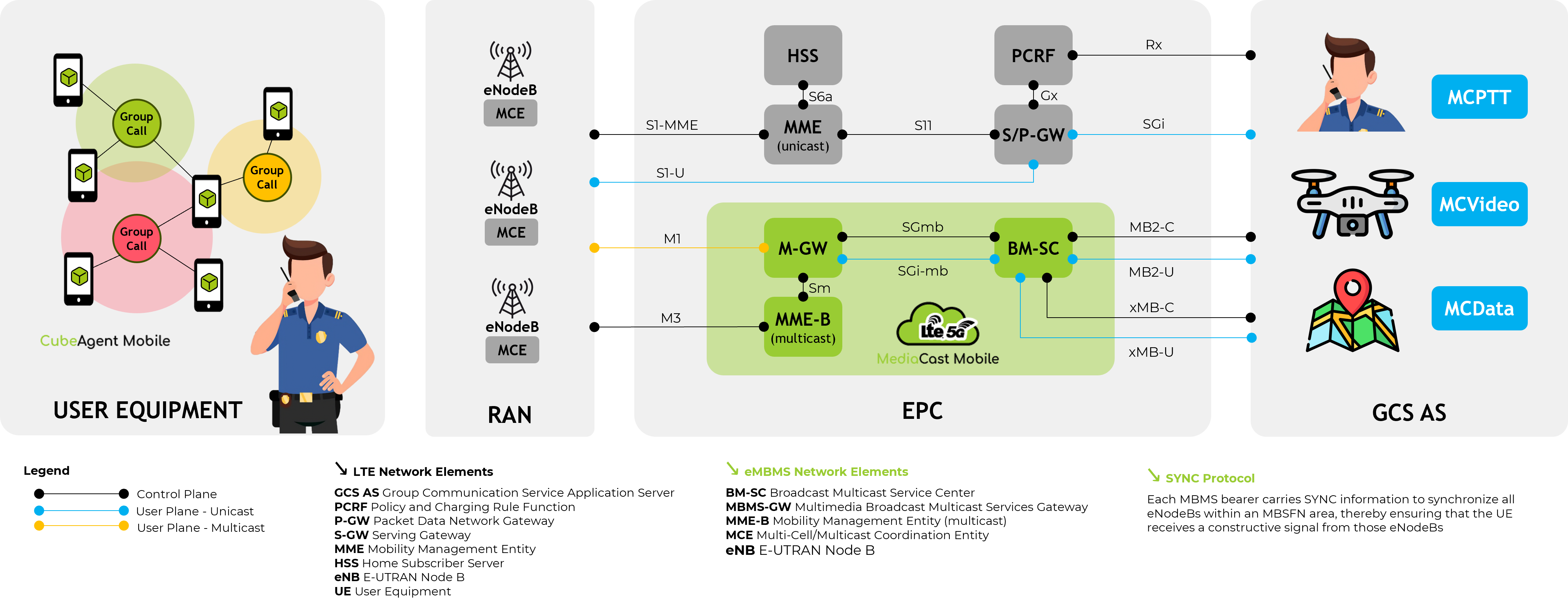
Deploying eMBMS requires specific 3GPP components across the entire chain, from the content source to the receivers. ENENSYS provides a complete, end-to-end multicast ecosystem:
-
Network Side (MediaCast Mobile): The core solution regroups the essential 3GPP logical entities. The BM-SC (Broadcast Multicast Service Center) acts as the host service for multicast content: it authenticates, authorizes and schedules each multicast session. The MBMS-GW (MBMS Gateway) handles the IP multicast routing of traffic toward the radio base stations, and the MCE (Multi-cell Coordination Entity) allocates radio resources and frequency across cells. Standard interfaces connect MediaCast Mobile to the core network, the radio network and mission-critical application servers.
-
Device Side (CubeAgent): A standard 3GPP eMBMS middleware installed on the device. It interacts with the modem, the operating system and mission-critical applications so that every user device acts as an efficient multicast receiver.
-
Validation & Lab (ccBOX): A compact «LTE & 5G network in a box», including a multicast gateway, BM-SC and radio, providing the perfect sandbox to test, validate and certify critical communications before large-scale field deployments.
eMBMS has already been tested and deployed in pioneer public safety networks around the world. Korea’s SafeNet, USA’s FirstNet and MoI Qatar have all incorporated broadcast multicast technology into their existing public safety LTE networks.
Highlights
Network Failure During Major Events?

The Hassle of Device and App Fragmentation?

High Costs of Ruggedized Devices?

Limited to Voice-Only Group Calls?

Delayed or Out-of-Sync Messages?

Benefits
- Extreme Scalability: eMBMS multicast serves thousands of users in a dedicated area
- Highly reliable and secure: better reception quality with eMBMS than with unicast streams
- Synchronized Delivery: all receivers get the same data at exactly the same time
- Fast File Download: eMBMS allows up to 2.5x faster file downloads in a semi-congested network
- Improved Spectral Efficiency: multicast uses radio and frequency resources far more efficiently than unicast, even for a small group of users
- Battery Saving: MBMS reception consumes fewer resources, increasing battery lifetime
- Future-Proof: eMBMS runs over commercial LTE networks, with a migration path to 5G-MBS on 5G networks


