
Blog
Scaling broadcast to handle 2026 Audience Peaks
Scaling broadcast to handle 2026 Audience Peaks
2026 will be the most-watched year in history.
From the slopes of Milano Cortina to the stadiums of North America, the 2026 broadcast calendar needs traditional broadcast infrastructure to evolve with Broadcast and Broadband convergence in order to scale.
Here are the audience peaks that will define the year. A converged infrastructure is the only way to master them.

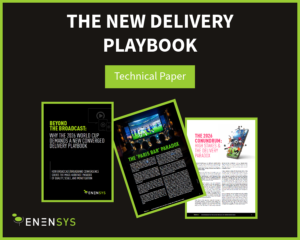
The New Delivery Playbook
The High Cost of a Loading Icon
During the 2022 World Cup final, right as Kingsley Coman began his run-up for a crucial penalty, a packed bar in Paris saw the one thing no broadcaster can afford: a buffering wheel. The screen went black, and with it, the most valuable ad inventory of the entire tournament simply evaporated. It is a structural business problem masquerading as a technical glitch, and as we look toward 2026, the math is only getting more difficult. Moving from HD to 4K isn’t just a bump in quality; it is a multiplication of network load that will likely see unicast delivery hitting a physical wall.
The way forward isn’t about choosing sides in a delivery war, but finally teaching the broadcast pipe to speak IP. We are looking at a converged playbook where DVB-NIP allows satellite to act as a massive edge offload for congested networks, bypassing the fiber backbone to feed 5G towers and fan zones directly. Standards like 5G Broadcast are emerging to solve the saturation problem by reaching millions of smartphones simultaneously without requiring a SIM card or an internet subscription. In the living room, DTV+/TV3.0 turns terrestrial airwaves into localized CDNs, finally enabling the one-to-one addressable advertising that rights-holders demand. Even for pure OTT players, Multicast is starting to bring the efficiency of broadcast into managed internet networks to survive these global spikes.
The viewers in 2026 won’t care if their winning goal arrives via a satellite beam or a terrestrial tower; they only care that the pixels actually show up. We’ve put together a deeper look at how to secure that “zero-fail” guarantee and reclaim relevance in a world of IP-native screens.
Download The New Delivery Playbook