
5G-MBS
Native multicast and broadcast for 5G networks
What Is 5G-MBS?
5G-MBS (5G Multicast Broadcast Services) is the 3GPP standard that brings native point-to-multipoint delivery to 5G Standalone networks. Introduced in Release 17, it lets a 5G network send the same content once to many devices, while keeping the flexibility to serve each user individually when needed.
Unlike its 4G predecessor eMBMS, 5G-MBS is built directly into the 5G Core and the NR radio. Multicast is no longer an overlay: the network decides in real time, cell by cell, whether point-to-multipoint or point-to-point delivery is the most efficient. This makes group communications, mass file delivery and live media both scalable and reliable on 5G.
Standardisation
5G-MBS is specified by the 3rd Generation Partnership Project (3GPP) and continues the path started with MBMS (3G) and eMBMS (4G):
- Release 17 – First 5G-MBS specifications: new 5G Core functions (MB-SMF, MB-UPF, MBSF, MBSTF), broadcast and multicast session modes, dynamic PTM/PTP switching in the gNB
- Release 18 – 5G-Advanced enhancements, including multicast reception for devices in RRC_INACTIVE state for better scalability and power saving
Key specifications include TS 23.247 (architecture), TS 26.502 and TS 26.517 (MBS user services and protocols) and TS 38.300 / TS 38.331 (NR radio procedures). Visit 3gpp.org for the latest versions.
How It Works ?
5G-MBS offers two service types. Broadcast sessions are received by all devices in an area, with no registration, which is ideal for public warnings or free-to-air content. Multicast sessions are delivered to a defined group of authorised users, such as a public safety team or a fleet of connected devices.
The 5G Core forwards a single copy of the content to each gNB (shared delivery). The gNB then chooses the best radio method for each cell: point-to-multipoint (PTM) when many group members are present, point-to-point (PTP) for a single user, and can switch between them without service interruption. Content is carried with standard IP formats such as DASH, HLS, RTP and file delivery with FEC.
Service Architecture
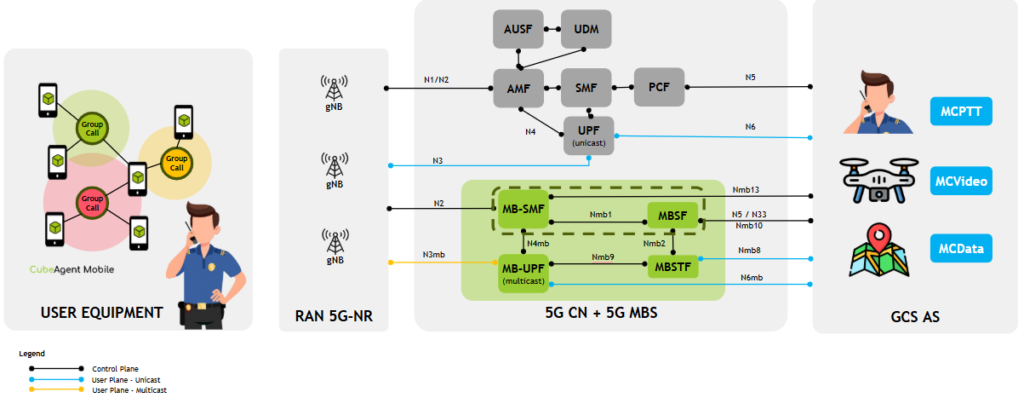
User service layer (MBSF / MBSTF) – Ingests content from application servers, provisions MBS sessions, applies FEC and handles service announcement to devices.
5G Core layer (MB-SMF / MB-UPF) – MB-SMF controls MBS sessions and QoS, MB-UPF replicates and forwards the multicast user traffic to the RAN.
Radio layer (gNB) – Decides in real time between point-to-multipoint and point-to-point delivery for each cell, and manages group reception.
Receiver side – 5G-MBS-capable devices, from smartphones and rugged terminals to CPEs and IoT modules, discover services and receive sessions through a dedicated middleware.
Key Advantages
- Native to 5G – Integrated into the 5G Core and NR radio, not an overlay network
- Dynamic and efficient – Real-time PTM/PTP switching per cell for the best use of spectrum
- Scalable and reliable – One transmission serves an unlimited number of users, with no loss of quality under load
- Broadcast and multicast – Open broadcast for everyone or managed multicast for authorised groups
- Energy efficient – Group reception, including RRC_INACTIVE from Release 18, reduces device power consumption
- Smooth migration – Keeps the proven principles of eMBMS, easing the move from 4G to 5G
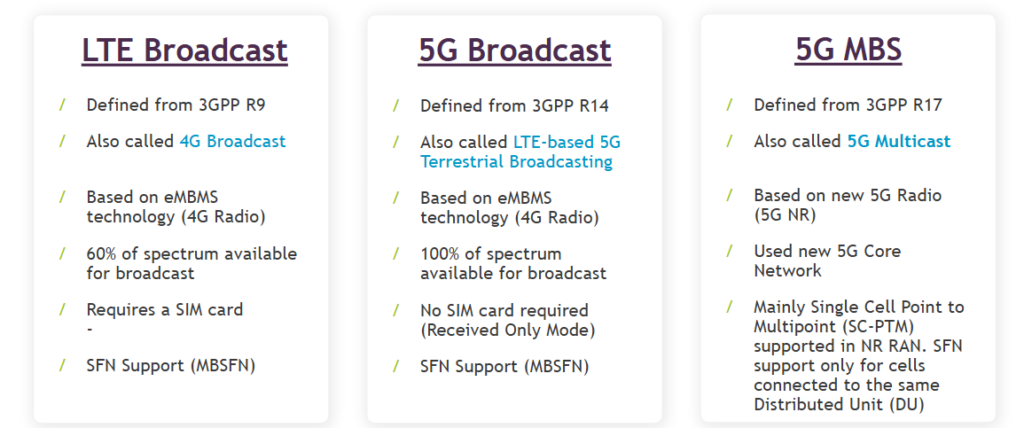
Comparing eMBMS / 5G Broadcast / 5G-MBS
Practical applications
1. Public safety and mission critical MCPTT, MCVideo and MCData group communications over 5G, with guaranteed performance during major incidents. The natural next step for public safety networks already using eMBMS on 4G.
2. Fixed Wireless Access (FWA) Deliver live TV and popular content once to many FWA customer premises equipment, reducing the load on the access network and improving quality at peak times.
3. IoT and utilities (including 450 MHz networks) Update firmware and configuration on thousands of smart meters, sensors and connected devices in a single transmission, with FEC for reliable delivery.
4. Private 5G networks Industry, ports, energy and transport operators broadcast group communications and operational data across sites.
5. Live media and events Stream live video to crowded venues and large audiences without saturating the network.
Looking ahead
5G-MBS makes multicast a native capability of 5G. As 5G Standalone networks and compatible devices roll out, it will become the reference for group communications and mass content delivery. With solutions supporting both eMBMS and 5G-MBS, ENENSYS helps operators start today on 4G and migrate to 5G with confidence.
[Discover eMBMS →]
FAQ
- What is 5G-MBS used for? 5G-MBS delivers the same content to many users at once over 5G: group calls, live video, public warnings, firmware updates and file distribution.
- What is the difference between 5G-MBS and 5G Broadcast? 5G Broadcast (FeMBMS) is based on the LTE radio and targets receive-only TV and radio services, without a SIM. 5G-MBS runs natively in 5G Standalone networks, with both broadcast and multicast modes, and dynamic switching with unicast.
- Does 5G-MBS require a 5G Standalone network? Yes. 5G-MBS relies on the 5G Core and is designed for 5G Standalone deployments, public or private.
- Are devices available? The device ecosystem is growing, with chipset vendors adding 5G-MBS support to their platforms. ccBOX lets manufacturers and developers validate 5G-MBS reception ahead of deployment.
- Can I migrate from eMBMS to 5G-MBS? Yes. 5G-MBS keeps the same service principles as eMBMS. ENENSYS solutions support both technologies to secure a smooth migration.
Learn More
Talk to our experts about preparing your network for 5G multicast.