
5G Broadcast
Reach Mobile Consumers for DTT operators

TERRESTRIAL NETWORKS
Traditional television is evolving, and the ENENSYS 5GBroadcast solution is the key for DTT operators to bridge the gap between the living room and the smartphone.
By complementing existing DTT network, the solution allows to target high-density major cities and broadcast directly to mobile devices that are compliant with 5GBroadcast technology. This gives the power to capture a younger, mobile-first demographic with entirely new, tailored content formats.
More than just extending coverage, the ENENSYS 5GBroadcast solution transforms monetization strategy by significantly increasing the reach and driving new TV revenues through highly targeted advertising. Ultimately, the solution is paving the way for a complete streaming DTT platform—allowing you to deliver Live TV, VoD, Replay, and CatchUp services over 5G networks.
Highlights
One-stop-shop solution
Reuse your transmitters to save CAPEX costs
Increase your reach
Paving the way for a DTT streaming platform
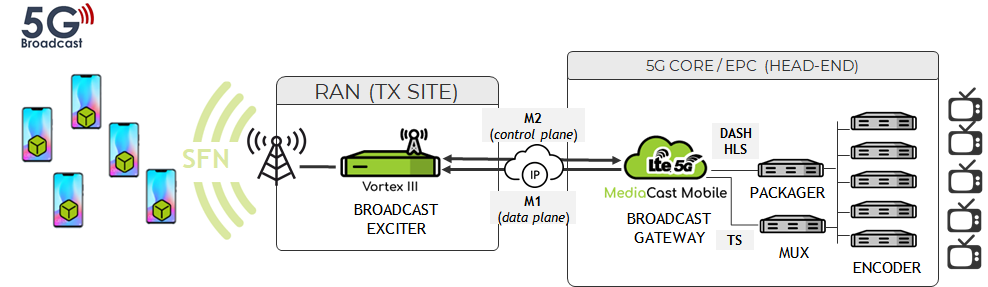
ENENSYS 5GBroadcast solution



Technical Architecture and 5G Broadcast Integration
5G Broadcast technology relies on a dedicated network infrastructure designed to deliver live video streams and data at scale without congesting cellular networks. By leveraging High Power High Tower (HPHT) transmitters or dense network layouts, it enables continuous linear transmission to an unlimited number of mobiles.
Components and 3GPP Standards Compliance
To ensure efficient Multicast traffic distribution and maintain a high Quality of Experience, the infrastructure pipeline incorporates standardized functional units:
- Core Network & Management: Native integration of BM-SC (Broadcast Multicast Service Center) and MBMS-GW functions to orchestrate broadcast sessions
- Modulation & Transmission: Full support for SFN (Single Frequency Network) and MFN topologies over terrestrial networks using advanced modulators/exciters such as Vortex III
- Standards & Spectrum: Full compliance with 3GPP specifications operating on UHF spectrum bands allocated for public service broadcast and critical operations
Advanced Applications: Live Streaming, Automotive, and Public Safety
5G Broadcast unlocks strategic B2B capabilities for broadcasters:
- Live sports and mass events: Delivers high-definition video streaming to mobile phones without consuming Unicast network capacity
- Connected vehicles data delivery: Simultaneous delivery of firmware updates and map data to automotive systems
- Public Safety alerts: Priority broadcast of critical emergency alerts during crises, bypassing mobile network congestion
Frequently Asked Questions (FAQ) – 5G Broadcast
What is 5G Broadcast and how does it differ from 5G Unicast?
5G Broadcast is a 3GPP-standardized technology that transmits a single content stream simultaneously to an unlimited number of mobile devices from a single transmitter. Unlike 5G Unicast, which establishes a point-to-point connection for each user and overloads spectrum during high-concurrency events, 5G Broadcast preserves network resources without degrading the Quality of Experience.
What are the main components of an ENENSYS 5G Broadcast architecture?
The end-to-end architecture relies on three technological pillars:
- MediaCast Mobile: This server is a Core Network. It provides BM-SC and MBMS-GW functions to orchestrate Multicast delivery sessions.
- Vortex III: This terrestrial modulator and exciter handles RF transmission over the broadcast network. It is multi-standard capable and supports 5G Broadcast as an option.
- CubeAgent Mobile: This software component (middleware) resides directly on the mobile devices. It is mandatory to enable mobile devices to receive and decode the Multicast streams.
Does 5G Broadcast reception require a SIM card or mobile subscription?
No. According to 3GPP specifications, 5G Broadcast in Receive-Only Mode (ROM) allows to receive video, audio, or data streams without a SIM card, without a cellular subscription, and without consuming mobile data plans.
Which 3GPP releases are supported by the solution?
The hardware and software components comply with eMBMS specifications defined by 3GPP, ensuring interoperability with modern LTE-B chipsets and mobile terminals.