
DVB-T2
DVB T2 tutorial
The DVB consortium (based in Europe) elaborated the DVB T2 technologie as an extension of the existing standard DVB-T, in order to allow a better use of the spectral resources by integrating edge cutting signal processing technologies. In the same frequency bandwidth, the expected gains give up to 50% additional bitrate.
DVB T2 baseline features
The specification is developed primarily for fixed roof-top reception antennas and has an identical frequency spectrum channel characteristics as DVB-T allowing a backward compatibility with the existing transmission infrastructure…
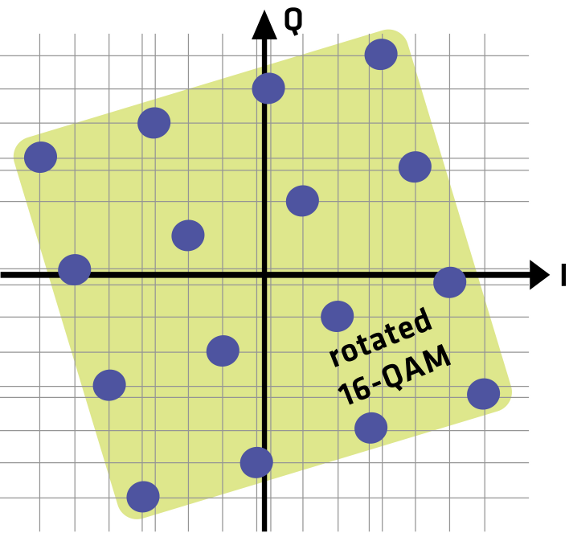
Like DVB-T, DVB T2 uses OFDM (orthogonal frequency division multiplex) modulation and provides a toolkit with different numbers of carriers (1k, 2k, 4k, 8k, 16k, 32k, 16k extended, 32k extended) and modulation constellations (QPSK, 16 QAM, 64 QAM, 256QAM). For error protection, DVB T2 uses LDPC (low density parity check) and BCH (Bose-Chaudhuri-Hocquengham) coding. A new technique, known as Rotated Constellations, has been introduced to provide additional robustness in certain conditions.
DVB T2 standard takes also care of transmitter equipments. In 32k particularly, high power peaks are generated and thus minimize the amplifier efficiency (or even endamage it). A special feature called PAPR (Peak Average Power Ratio) reduction has been included in the standard specifications to limit these peaks power without losing information.
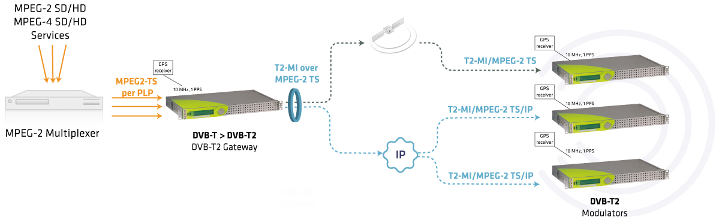
DVB T2 system architecture
The main differences between a DVB-T and DVB T2 system is that the multiplexer shall be connected to a T2 gateway. This T2 gateway receives one or several multiplex e.g one per PLP from the multiplexer and encapsulates these datas into BaseBand Frames. The T2 gateway send the content to DVB T2 modulators via the T2 Modulator Interface protocol.
DVB T2 vs DVB T comparison
| FEC | LDPC + BCH | CC + RS |
| Code rate | 1/2, 3/5, 2/3, 3/4, 4/5, 5/6 |
1/2, 2/3, 3/4, 5/6, 7/8 |
| Constellation | QPSK, 16QAM, 64QAM, 256QAM | QPSK, 16QAM, 64QAM |
| Guard Interval | 1/4, 19/256, 1/8, 19/128, 1/16, 1/32, 1/128 | 1/4, 1/8, 1/16, 1/32 |
| FFT size | 1K, 2K, 4K, 8K, 8K ext., 16K, 16K ext., 32K, 32K ext. |
2K, 8K |
| Scattered pilots | 1%, 2%, 4%, 8% of total | 8% of total |
| Continual pilots | 0,35% of total | 2,6% of total |
| Bandwidth | 1.7, 5, 6, 7, 8, 10 MHz | 5, 6, 7, 8 Mhz |
| Max. Bandwidth | 50,34 Mb/s | 31,66 Mb/s |
DVB T2 Frame structure
DVB T2 reuse the PLP or Physical Layer Pipe concept introduced in the DVB-S2 specification. A PLP is a logical channel that may carry one or multiple services. Each PLP can have a different bit rate and error protection parameters. For example, it’s possible to split SD and HD services to different PLPs. An other example is the New Generation Handeld (DVB-NGH) standard that will be based on multiple PLP feature to enable broadcast mobile TV over DVB-T2. The PLP can be with static (CBR) bit rate or Dynamic (VBR) bitrate
The DVB T2 standard define several profiles :
Type A : single stream input ie. mono PLP
Type B : multi stream input i.e multi PLP. In multi PLP mode the PLPs are time sliced. The multi PLP mode is subdivised in several modes:
– Type 1 : PLP having one slice per T2 frame. Allow better amount of power saving that the receiver can perform
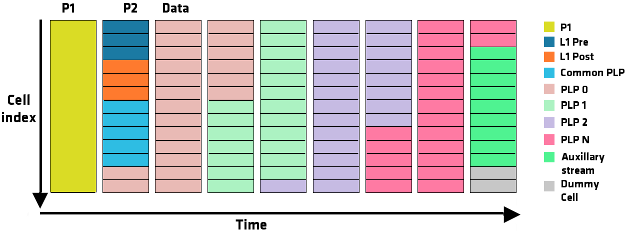
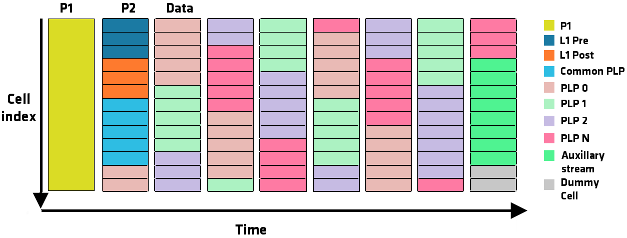
– Type 2 : PLP having two or more sub-slices per T2 frame. Increase time diversity. The number of sub-slices should be as large as possible, if the receiver power saving is not an issue.
-Time Frequency Slicing (TFS), creates a large multiplex by combining radio-frequency channels (up to 6 frequencies) to make a single ‘virtual’ channel to allow efficient statistical multiplexing. The TFS is optional in the current DVB T2 specification.
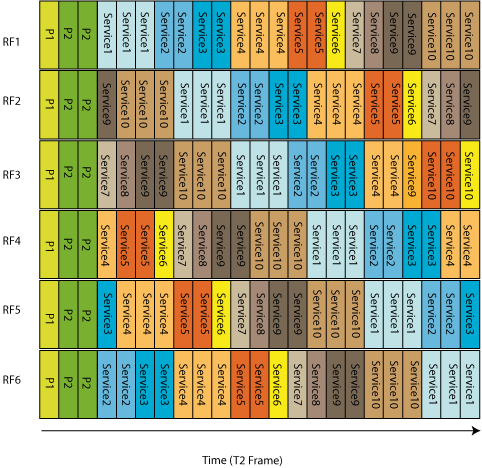
It’s possible to define the type 1 or 2 for each PLP and then to mix in a T2 frame PLPs of type 1 and PLPs of type 2.
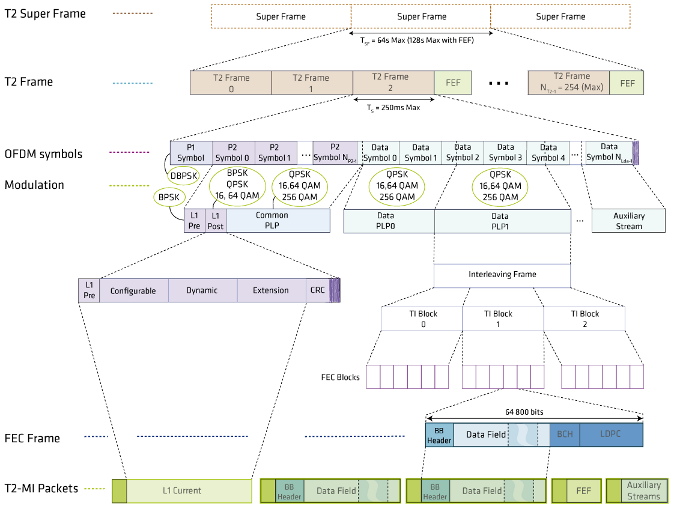
The PLPs are combined into T2 Frames. A T2 Frame starts with preambule P1 and P2. The T2 framing structure is described are after.
DVB T2 Modulator Interface
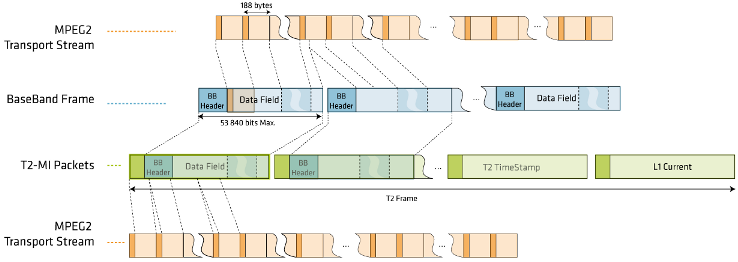
The T2 gateway encapsulates data into BaseBand frame. These BB frames are send to the DVB T2 modulator over a specific DVB T2 Modulator Interface protocol described hare after.
DVB T2 Rebroadcasting
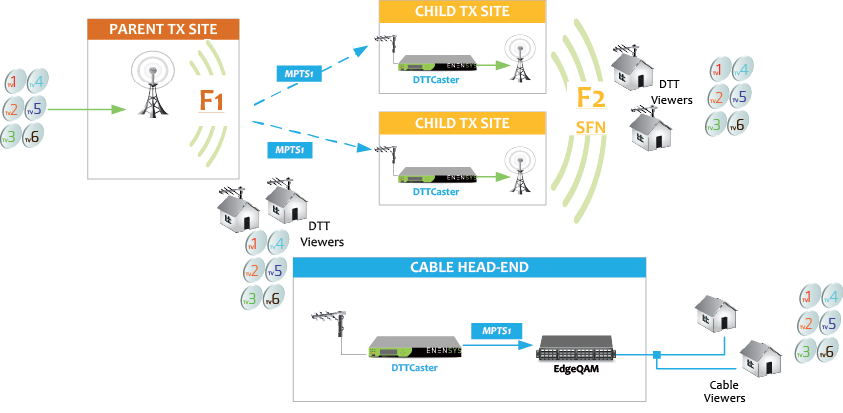
The T2 standard allow also SFN rebroadcasting of child transmitters using the RF signal coming from a parent transmitter. The child and parent transmitters must use different frequencies
Adopting the new DVB T2 standard
The market quickly adopt DVB-T2 and more than 40 countries already deployed commercial networks using this standard :Sweden, Finland, Estonia, Belarus, Belgium, Croatia, Austria, UK, Italy, Denmark, Serbia, Ukraine, Russia, Colombia, Haiti, New Zealand, Indonesia, Vietnam, Singapore, Thailand, Qatar, Oman, Saudi Arabia, Bahrain, Kuwait, Uganda, Kenya, Nigeria, Ghana, Tanzania, Zambia, South Africa, Malawi, Zimbabwe, Namibia, Togo, Rwanda, …
- DVB T2 Glossary
- BB
- BaseBand
- FEC
- Forward Error Correction
- FEF
- Future Extension Frame
- MISO
- Multiple Input Single Output
- PAPR
- Peak to Average Power Ratio
- PLP
- Physical Layer Pipe
- T2-MI
- T2 Modulator Interface
- TI Block
- Time Interleaving Block
- TFS
- Time Frequency Slicing
- LDPC
- Low Density Parity Check
- BCH
- Bose Chaudhuri Hocquengham
References:
– DVB website : http://www.dvb.org/technology/standards/
– Wikipedia : http://en.wikipedia.org/wiki/DVB-T2